If you don't know how to use your radar detector, it may do you more harm than good. - Radar Roy
I have spent 20 years in law enforcement and as a certified traffic radar instructor has trained hundreds of officers in the correct operation of traffic enforcement equipment. Follow my Rules of the Road to maximize the effectiveness of your radar detector.
Keep Your Radar Detector
At least once a week, I receive a telephone call from one of my thousands of clients asking for a copy of their invoice, because their radar detector was stolen by some "crack head" to sell it for their next fix.
Some report that they had their detector stolen when they just "ran into" their neighborhood convenience store.
Extreme heat, caused when you leave your car parked for extended periods during summer months can also damage your detector. Some of the newer, higher end radar detectors have reported sensor problems once the internal temperature went over 145 degrees. Owners of these detectors receive calibration error messages and have had to return the units to the manufacture for repair or replacement.
This is why I recommend that when you leave your car unattended, even for a moment, conceal your valuable items (including the radar detector and mounting hardware) in the truck, glove box or under the seat and to lock your car!
Stay Alert
Using a radar detector isn't enough. you must be ALERT at ALL TIMES to ALL driving conditions." - Radar Roy
After driving a few days with your newly purchased radar detector, you will become more secure in its abilities as it successfully alerts you of your neighborhood "speed traps". I caution however. as you confidence increases in your detectors abilities, don't fall into the trap of becoming a "stupid driver" and start making mistakes.
The most important thing you can do to avoid a costly traffic ticket it to keep alert of what is happening around you and to respond accordingly!
The radar detector can't protect you against everything. Your radar detector is designed to respond to radar and laser signals it receives and that is all. There are many other methods law enforcement use to accurately estimate your speed and issue you that citation. However, if you are paying attention and know what to look for, you can reduce your chances of being caught.
Aircraft Enforcement: In some parts of the country police routinely use aircraft to obtain speed readings. Often a good giveaway are the large painted white lines on the pavement. These painted lines are used by observers in the aircraft to measure the time it takes you to cross over them. They then radio a waiting patrol unit ahead with your speed and vehicle description.
VASCAR: a computer that calculates your average speed from one point to another. An officer can also use a stop watch. The painted lines in the highway are often a good indicator that this enforcement practice is used in the area, but the officers often use other devices to measure distance. An officer can measure a guard rail from point A to point B then program this distance into his VASCAR system. An officer can also pace you with VASCAR. As you pass two points he enters them into his system. Then the computer calculates your average speed.
Laser Enforcement: A growing trend today are police departments moving to laser (lidar) enforcement and it is estimated that there are over 50,000 police laser guns in use today in the USA.
These guns transmit a beam of infrared light at a frequency of 330 terahertz. This light beam is only 18 inches wide at 500 feet and gets smaller as you approach the officer.
This narrow light beam is aimed by the officer to a reflective area on your vehicle, such as your headlamps or front license plate. The officer can only use the laser gun while he is stationary.
Unless your radar/laser detector is within this 18" circle, or it picks up "scatter" from the beam, your radar detector will never alert. And by chance it does, it is too late as the officer has already obtained your speed.
To protect yourself from Laser Enforcement, we recommend laser jammers.
Speed Sensors:
A technology that is now being employed are speed sensors planted in the pavement and then cameras that photograph you if you speed.
They then mail you the citation. Some area have signs posted in the area of these devices warning drivers to slow down. Read the signs, avoid the ticket!
Red Light Cameras: Although they are not designed specifically for speed enforcement, red light cameras are now gaining in popularity across the nation as a way to decrease traffic accidents (and increase tax revenue)
To protect you against these types of photo enforcement encounters we would recommend a radar detector that has GPS features that have these locations programmed into the detector, such as the Passport Max2.
Pacing: Perhaps the oldest and most popular method of obtaining a speed reading of a violator by police. Simply put, the officer follows you in his car (or drives ahead of you) and matches your speed to his. After a short distance he obtains a speed of your vehicle and pulls you over. Be alert, is that car behind you smoky?
Mount Your Detector Properly
The Number 1 Question I receive from clients is how to properly mount their radar detector in their vehicle. Their are basically two types of electronic transmitting devices police can use to capture the speed of your vehicle, radar guns and laser guns.
Radar is the most common. Radar is basically a microwave radio signal. At 1000 feet, a radar beam shot from a police radar gun is approximately 85 feet wide. This radar beam can normally penetrate glass, plastic, cardboard and even your body. What radar has a problem penetrating are metals, including some window tints that have meatlized layers.
Laser is a light beam and is only 18" wide at 500 feet. Because the beam is so narrow, and because it's light, the beam can be effected by virtually anything you put between the laser gun and the detector.
Don't mount it high!
During the testing of the products I review the radar detector is always mounted in the manner the manufacture recommends in their manual, in the center of the windshield.
However you will see on this page, that mounting it in this manner will not allow it to receive laser alerts. A laser beam shot at 500 feet is only 18" wide when it hits your vehicle. Police target either the front license plate or the headlamps. If the radar detector is mounted in the center of the windshield, it will be too high to receive any of the "splatter" that may indicate you are being targeted by a police laser gun.
There are also several other problems with this method:
In most cases, mounting the radar detector in this position will place it in the center of the windshield. This can cause a visual obstruction while you are driving. In Minnesota, it is illegal to mount anything to your windshield that may obstruct your vision (169.71: No person shall drive or operate any motor vehicle with objects suspended between the driver and windshield)
Mounting a radar detector too high will cause you to take your eyes off the road when it is activated.
If left in your car while parked, you will be exposing it to thieves.
This position is also a dead give away for law enforcement that you have a countermeasure device. While Radar Roy was a traffic officer, it was common to pull behind a motorist who was speeding and see their radar detector mounted directly in the center of the windshield. Even though the use of a radar detector is legal in all states, with the exception of Virginia and Washington D.C., some officers don't appreciate their use. You will have a better chance of getting a break, if you make it less noticeable.
You will have other motorists following behind making you their trailblazer. If you then encounter an emergency situation and slam on your brakes, the vehicles following may slam into you.
Mount it Low!
Consider using Velcro to mount your detector on the dash or using the supplied windshield mounting brackets and mounting it low on the windshield. By mounting it this way, making sure that the windshield wipers are not blocking the front, you will draw the least amount of attention and obtain the best laser and radar detection.
Ensure that the controls are accessible
Make sure that you can easily reach the volume and mode controls (highway, city and mute) on your detector. For models that have "Smart Cords", such as the Beltronics PRO 500 and the Escort 8500 X50, get in the habit of muting your system with the button on the cord, rather than the detector, if it is easier to reach. For those models without automute, you MUST have easy access to the controls if you want to keep the detector from screaming at you for an extended period of time.
Radar Detector Mounting Laws
It's perfectly legal to own and operate a radar detector in the states of California and Minnesota, but if you have one mounted to your windshield you can be ticketed!
Both California and Minnesota have laws that make it illegal to affix anything to your windshield
Because of this if you mount your cell phone, GPS or radar detector to your windshield you can be cited
The radar detector issues a weak signal and you brush it off. This is perhaps the BIGGEST operator error made, ignoring the warning! You may think that it is a false alert or the signal wasn't strong enough to be concerned about. A short time later your radar detector goes off again and you are caught!
To avoid an ambush, I recommend that you understand some of the signals and alerts that your detector will provide.
When most detectors alert, they will display the band and the signal strength.
Band Alerts
X Band:
This is the oldest radar band, used by police in N. J. and several locations in Ohio. Chances are, unless you are in one of those states, you can ignore this alert. False alerts on this band are high to extreme (depending upon detector model and driving location)
K Band:
Thirty percent of the radar guns manufactured today use this band. False alerts on this band are moderate
Ka Band:
Seventy percent of the radar guns manufactured today use this band. False alerts are low to moderate
Laser:
Growing in popularity with police departments nationwide, false alerts are low. When false alerts are encountered, normally they are reflection of bright sunlight, or wind shear monitors at airports or weather stations a
As demonstrated in the video above, most detectors will alert you of the strength of the radar signal with a graph or row of lights. The closer the officer, the higher the signal strength.
The Ambush
During this 1-minute video you'll discover why its important to have a "rabbit" in front of you during an instant on ambush.
These types of ambushes frequently happen after you receive a weak signal and ignore it as a false alert. This alert can be an indication of the following:
All police radar guns are directional, meaning they send the signal in the direction the gun is pointed. As you approach an officers location, it maybe pointing in another direction, thus the weak signal on your radar detector. As you approach, it is re-targeted toward your location.
The law enforcement officer is further down the road, using his instant-on radar gun.
Another law enforcement trick is to do radar enforcement in locations known for false alerts. Regular travelers of this route start ignoring the usual alert that they receive when in this area. To avoid this trap, consider a detector that has the ability to detect multiple threats
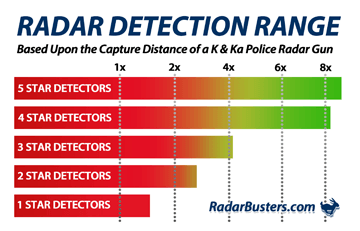
A good formula to use to determining if the range of your radar detector is adequate to avoid an ambush is "Capture Area x 6". This formula is allows you to detect the police in enough time to safely slow down and to observe the events taking place around you, to then determine the reason for the alert.
New Jersey Superior Court Judge Reginald Stanton's ruling which stated that an officer should not target vehicles further then 1000' could be used as a baseline. However very few officers know anything about this ruling and often start obtaining a vehicle tracking history the moment that they observe your vehicle.
Under normal circumstances, the longest range an officer can lock on and make any type of target vehicle identification on a flat roadway using radar, is approximately 1/4 of a mile. Therefore using my formula, you would want to have a detector that has at least, 1.5 miles of detection.
However, there are also some variables in the where police speed enforcement is used, such as hills and curves. Therefore, if you live or drive in an area that has allot of curvy, mountainous roads, you would want to increase your capture area to at least a four mile distance.
During one of my latest Long Range Test the Passport Max2 was able to detecting K and Ka band signals at a distance of over 8 miles away.
Therefore, when your radar detector goes off, make sure that you are traveling at the legal speed limit and are obeying all other traffic rules, until you are SURE the threat has ended.
Use the correct mode
"You’ll go crazy listening to false alerts if you don’t use the correct mode.” – Radar Roy
Use City Mode for city
When driving in the city, switch your radar detector over to city
mode. This will reduce the sensitivity of the radar detector (usually on
X band only) or leave the sensitivity unchanged and raise the threshold
of the unit, when the audio alerts sound.
By doing this, you will significantly reduce the number of false alerts your radar detector will receive.
Hopefully,
you will have a more relaxed driving experience without having to
listen to your radar detector’s false alerts to other devices such as
automatic door openers, alarm systems and even other radar detectors.
Use Highway Mode for highways
When you activate highway mode on your radar detector:
You increase the sensitivity of your radar detector to receive at its maximum range
Your detector’s audio alerts are restored for low signal strength encounters
Your detector is at maximum performance and more likely to warn you of threats ahead on the roadway, including instant-on radar.
For the VERY BEST range on the highway, always use Highway Mode!
AUTO MODE
"You can forget about the changing modes with the new Escort and Beltronics GPS enabled radar detectors" – Radar Roy
All
of the GPS based Radar Detectors offered by both Escort and Beltronics
such as the Passport Max and Max2 and the Escort
9500ci automatically sense the speed that you are
driving and adjust the sensitivity accordingly if switched into auto
mode.
Escort Live - Speed Trap Protection from the Cloud!
The newest speed counter measurement technology enables your radar detector to share real time alerts with other Escort and Beltronics radar detector users called Escort Live.
During this video you'll witness first hand an Police Spotted Escort Live alert warning of a VASCAR speed trap.
React Immediately
Each millisecond an officer is prevented from obtaining a tracking history
report means miles per hour taken off your speed if you react in time.
Even if the effort seems fruitless, apply your brakes immediately upon being warned by your radar detector. If you apply your brakes immediately, you could beat an officer to the punch, even if he is using instant-on radar.
Remember, police radars are machines and don’t ALWAYS work correctly.
Warning:
Always be alert of road conditions when applying your brakes,
especially when driving in inclement weather, on roads with potholes, and/or when other vehicles are close behind.
This site is family owned and founded by "Radar Roy," a retired police officer and certified traffic radar instructor, who is considered a leading expert in the speed counter measurement industry.
To learn more about Roy, read our radar detector reviews, or download our free radar detector eBook click here.
Return Policy
Dash Mounted Radar Detectors, Accessories, Mounting Systems: These products come with our 30-day money back guarantee provided that they are returned in
resalable condition. This requires that all parts, accessories, warranty
cards and packaging are returned.
Installed Products: Any radar detector/laser jammer product that requires installation is exempt from our 30-day return policy if the product is removed from the packaging and/or if the buyer installs
and/or attempts to install the product on a vehicle it becomes a
nonreturnable product.
This exception includes all laser jammers, installed radar detectors, and the Veil Stealth Coating.




 This site is family owned and founded by "Radar Roy," a retired police officer and certified traffic radar instructor, who is considered a leading expert in the speed counter measurement industry.