

Radar Busters
Uniden DFR7
Uniden DFR7
Free 2-day FedEx · No sales tax outside Arizona
UNIDEN DFR7
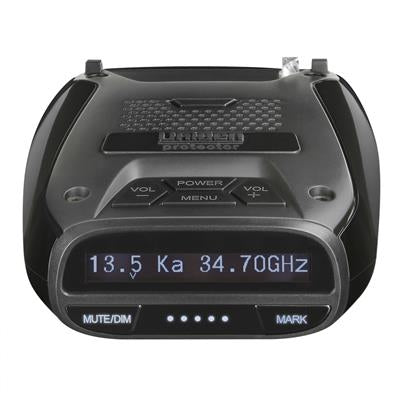
Uniden DFR7 radar detectors provide high-performance at a very low price point.
Or click the following link to purchase:
BUY Uniden DFR7 Radar Detector
- Free 2-Day FedExOrders over $199
- 1-year warrantyAuthorized Radar Busters dealer
- Expert helpReply within 12 hours
Uniden DFR7 Review
Updated: 07-11-2025Overview
The Uniden DFR7 replaces the Uniden LRD-950.For its price range the Uniden DFR7 offers a lot of value for the money.
Testing so far the Uniden DFR7 is surprising everyone with its sensitivity and this Uniden is being is often being compared to radar detectors that cost more than double its price.
For a detector with upgradable firmware, GPS for red light and fix speed cameras and the ability to lock out and ignore false alerts, there are not many detectors the perform as well of the Uniden DFR7 in its price range.
If you are looking for a smart upgrade to the Uniden DFR7, we recommend the more capable Uniden R3.
- The Uniden DFR7 Provides Long Radar Detection Range
- Built-in GPS (Redlight and Speed Camera Alerts:(Uniden DFR7 vs Uniden DFR6)
- 360° Laser Detection
- X, K, KA SuperWideband Detection
- Advanced K-band false signal rejection and filtering
- OLED - Easy to read OLED display
- Quiet ride - Mutes alert below your set speed
- Mute Memory - Mutes by logging Frequency and GPS location
- Text Alert Readout
- Voice Alert
- Digital Navigator™ Electronic Compass
- VG-2 Undetectability
- Signal Strength Meter
- City/Highway Modes
- Firmware & Database Updates
- Suction Cup Mount
- Cigarette Lighter Power Adapter with USB and Mute Button
Filtering
One of the main benefits of the Uniden DFR7 radar detectors is that it provides very good filtering to K-band automotive collision avoidance and lane departure systems so common today as well as GPS lockout of known stationery false sources of radar.Easy Advanced Programming
Programming your Uniden DFR7 for the conditions you drive is easy. Just press the menu button and you can select from various different options that include the sensitivity, the filtering, the brightness of the display and more.Included Accessories
Your Uniden DFR7 comes shipped to your door with everything you need including windshield mount, 12-volt accessory power cable with USB data port, carrying case, single and dual suction cup mounts, and an instruction manual.Why Purchase Through RadarBusters?
Expertise: RadarBusters is one of the longest operating and most experienced countermeasure-dedicated companies in the industry. We are not a big box electronics store that offers everything under the sun. You will find no other company that offers the same level of pre- and post-sales expertise, than us.
Authorized from Uniden: RadarBusters is an authorized affiliate for the Uniden DFR7, so you can be assured that your detector is covered under Uniden's full warranty. A Uniden order placed after 2/3/25 will be performed as an affiliate link where RadarBusters receives a small commission for the sale to support our operation, rather than a markup from wholesale as was previously done. We greatly appreciate your support via this revised purchasing method.
Real Reviews: Unlike the other review websites out there, RadarBusters was founded by Radar Roy, a retired cop and certified traffic radar instructor with over 40 years of experience. Luxury Automotive was so impressed with our high standards and qualifications that they dubbed us the “General Schwarzkopf of radar detectors”.
We Have Answers: Have a question or concern? Please call or email us and we will be happy to assist you. If you think you are having an issue with your product in most cases we should be able to help you resolve it over the phone.
Q: What are the different radar detector bands?
A:
- X-Band 10.525 GHz +/- 25 MHz
- An older band, mostly used by automatic doors in supermarkets and rarely used by law enforcement anymore. You can eliminate this band by turning off X band in the menu.
- K-Band 24.150 GHz +/- 100 MHz
- A potential radar strike that could also be a non-radar law enforcement. Know the area as many police still utilize this band.
- Ka-Band 34.700 GHz +/- 1300 MHz
- Alert! It’s the police. One of the most common used bands by law enforcement today.
- Laser 904nm, 33 MHz bandwidth
- Alert! It’s the police. Higher law enforcement such as state troopers often use laser.
Q: Are radar detectors allowed in my state?
A: Radar detectors are currently banned in some states in the U.S. Enclosed is a list and link to American Auto Association AAA, which keeps an ongoing list of permitted states.
ALABAMA — Radar detectors are permitted for passenger vehicles but prohibited for use by commercial vehicles.
ALASKA — Radar detectors are permitted for passenger vehicles but prohibited for use by commercial vehicles.
ARIZONA — Radar detectors are permitted for passenger vehicles but prohibited for use by commercial vehicles.
ARKANSAS — Radar detectors are permitted for passenger vehicles but prohibited for use by commercial vehicles.
CALIFORNIA — Radar detectors are permitted for passenger vehicles but prohibited for use by commercial vehicles.
COLORADO — Radar detectors are permitted for passenger vehicles but prohibited for use by commercial vehicles.
CONNECTICUT — Radar detectors are permitted for passenger vehicles but prohibited for use by commercial vehicles.
DELAWARE — Radar detectors are permitted for passenger vehicles but prohibited for use by commercial vehicles.
DISTRICT OF COLUMBIA — Radar detectors are not permitted.
FLORIDA — Radar detectors are permitted for passenger vehicles but prohibited for use by commercial vehicles.
GEORGIA — Radar detectors are permitted for passenger vehicles but prohibited for use by commercial vehicles.
HAWAII — Radar detectors are permitted for passenger vehicles but prohibited for use by commercial vehicles.
IDAHO — Radar detectors are permitted for passenger vehicles but prohibited for use by commercial vehicles.
ILLINOIS — Radar detectors are permitted for passenger vehicles but prohibited for use by commercial vehicles.
INDIANA — Radar detectors are permitted for passenger vehicles but prohibited for use by commercial vehicles.
IOWA — Radar detectors are permitted for passenger vehicles but prohibited for use by commercial vehicles.
KANSAS — Radar detectors are permitted for passenger vehicles but prohibited for use by commercial vehicles.
KENTUCKY — Radar detectors are permitted for passenger vehicles but prohibited for use by commercial vehicles.
LOUISIANA — Radar detectors are permitted for passenger vehicles but prohibited for use by commercial vehicles.
MAINE — Radar detectors are permitted for passenger vehicles but prohibited for use by commercial vehicles.
MARYLAND — Radar detectors are permitted for passenger vehicles but prohibited for use by commercial vehicles.
MASSACHUSETTS — Radar detectors are permitted for passenger vehicles but prohibited for use by commercial vehicles.
MICHIGAN — Radar detectors are permitted for passenger vehicles but prohibited for use by commercial vehicles.
MINNESOTA — Radar detectors are permitted for passenger vehicles but prohibited for use by commercial vehicles.
MISSISSIPPI — Radar detectors are permitted for passenger vehicles but prohibited for use by commercial vehicles.
MISSOURI — Radar detectors are permitted for passenger vehicles but prohibited for use by commercial vehicles.
MONTANA — Radar detectors are permitted for passenger vehicles but prohibited for use by commercial vehicles.
NEBRASKA — Radar detectors are permitted for passenger vehicles but prohibited for use by commercial vehicles.
NEVADA — Detectors are permitted for passenger vehicles but prohibited for use by commercial vehicles.
NEW HAMPSHIRE — Radar detectors are permitted for passenger vehicles but prohibited for use by commercial vehicles.
NEW JERSEY — Radar detectors are permitted for passenger vehicles but prohibited for use by commercial vehicles.
NEW MEXICO — Radar detectors are permitted for passenger vehicles but prohibited for use by commercial vehicles.
NEW YORK — Radar detectors are permitted for passenger vehicles but prohibited for use by commercial vehicles.
NORTH CAROLINA — Radar detectors are permitted for passenger vehicles but prohibited for use by commercial vehicles.
NORTH DAKOTA — Radar detectors are permitted for passenger vehicles but prohibited for use by commercial vehicles.
OHIO — Radar detectors are permitted for passenger vehicles but prohibited for use by commercial vehicles.
OKLAHOMA — Radar detectors are permitted for passenger vehicles but prohibited for use by commercial vehicles.
OREGON — Radar detectors are permitted but are prohibited for use by commercial vehicles.
PENNSYLVANIA — Detectors are permitted for passenger vehicles, but prohibited for commercial vehicles.
RHODE ISLAND — Radar detectors are permitted for passenger vehicles but prohibited for use by commercial vehicles.
SOUTH CAROLINA — Radar detectors are permitted for passenger vehicles but prohibited for use by commercial vehicles.
SOUTH DAKOTA — Detectors are permitted for passenger vehicles but prohibited for use by commercial vehicles.
TENNESSEE — Detectors are permitted for passenger vehicles but prohibited for use by commercial vehicles.
TEXAS — Radar detectors are permitted for passenger vehicles but prohibited for use by commercial vehicles.
UTAH — Radar detectors are permitted for passenger vehicles but prohibited for use by commercial vehicles.
VERMONT — Radar detectors are permitted for passenger vehicles but prohibited for use by commercial vehicles.
VIRGINIA — Detectors are not permitted.
WASHINGTON — Radar detectors are permitted for passenger vehicles but prohibited for use by commercial vehicles.
WEST VIRGINIA — Radar detectors are permitted for passenger vehicles but prohibited for use by commercial vehicles.
WISCONSIN — detectors are permitted for passenger vehicles but prohibited for use by commercial vehicles.
WYOMING — Radar detectors are permitted for passenger vehicles but prohibited for use by commercial vehicles.
PUERTO RICO — Radar detectors are permitted for passenger vehicles but prohibited for use by commercial vehicles.
Q: What is the difference between HIGHWAY and CITY mode?
A: Radar detectors operate with various sensitivity levels. These levels determine the types of signals and signal ranges (bands) detected. Highway mode is the most sensitive level while City mode is the least sensitive. If the X band is left on in City mode, a radar detector can pick up many X band signals (such as garage door openers) that generate false alerts. The DFR6 turns off the X band for City mode. When you are on the highway, there is less chance of picking up X band false alerts, so the DFR6 keeps the X band on.
Q: My Uniden DFR7 detector is alerting K band when no law enforcement is around.
A: One thing radar detectors are competing against for newer cars are the safety sensors. Cars that emit collision avoidance, lane monitoring, stop monitoring and similar features can set off the K band on the radar detector. To solve this issue, you can set the K band filter to ON, but this will lessen the capability to notify you to true K band alerts.
| Receiver Type | Antenna Type | ||
| Radar | Double Conversion Super-Hetrodyne Self Contained Antenna | Radar | Linear Polarized E-vector Vertical |
| Laser | Pulsed Laser Signal Receiver |
Laser
Front Back |
Convex Condenser Lens Concave Condenser Lens |
| Radar Detected | |||
| X-band | 10.525 GHz | Dimensions | 110.00 mm (D) x 69.00 mm (W) x 29.50 mm (H) |
| K-band | 24.150 GHz | Weight | 4.9 oz (140 g) |
| Ka | 33.400 - 35.700 GHz | Operating Temp. | 32° to +158° F (Radar/Laser) -10° to +70° C (Radar/Laser) |
| MRCT/MRCD | FMCW K-band | Storage Temp. | -22° to +203° F (Radar/Laser) -30° to +95° C (Radar/Laser) |
| Police Laser | 800nm-1,100nm (905nm nominal) |
|